Photon Fees Explained (2026): The Real Cost of Every Trade
Table of Contents
- What Photon actually charges
- The referral discount that does not exist
- What is not a Photon fee
- The fee drag math
- Cumulative cost over 10, 50 and 100 round trips
- The win rate you need
- How Photon's 1% compares in 2026
- What the revenue collapse says about the fee
- How to check what a trade actually cost you
- Cutting your actual cost on Photon
- The verdict
Photon charges a flat 1% of the SOL amount on every buy and again on every sell, stated verbatim in Photon's own GitBook. There are no volume tiers, no published referral discount, and no documented history of the rate ever being anything else. A 5 SOL buy pays 0.05 SOL. A sale that returns 1 SOL pays 0.01 SOL. Wallet-to-wallet transfers are not charged. Because the sell fee applies to your exit proceeds rather than your entry, a round trip that ends flat still costs you 1.99% of the balance, and the token has to rise about 2.03% before you break even on Photon's fees alone. Five other costs land on the same transaction and none of them is Photon's: Solana's base fee of 5,000 lamports per signature, the priority fee and the Jito bribe you set yourself, the pool's own fee, and slippage. On published rates Photon is the most expensive of the major three, with Axiom documenting 0.75% at its top tier and GMGN 0.70% with a referral code.
Almost every page written about that one line gets the surrounding context wrong, which is the reason this one exists. It separates each cost, quotes a source for every number, does the arithmetic on what a 2% round trip does to an account over a hundred trades, and then shows you how to read the real total off your own transaction afterward.
Disclosure: this site carries referral links to Photon. Signing up through them costs you nothing extra, because Photon publishes no referral discount and applies no surcharge either.
Photon's 1% is the predictable line on your transaction, and usually not the biggest one. The priority fee, the Jito bribe and your slippage tolerance are all set by you, all paid to somebody other than Photon, and together they vary far more than the platform fee ever will. Traders who pick a terminal on its headline rate and then run an aggressive preset into a thin pool lose more to the settings than to the fee.
What Photon actually charges
Straight from Photon's own GitBook, the Solana fee page reads:
"Photon fees are collected in SOL and it is 1% of the initial token used for every buy and sell transaction."
You do not have to take our word for it. Here is that page as Photon publishes it:
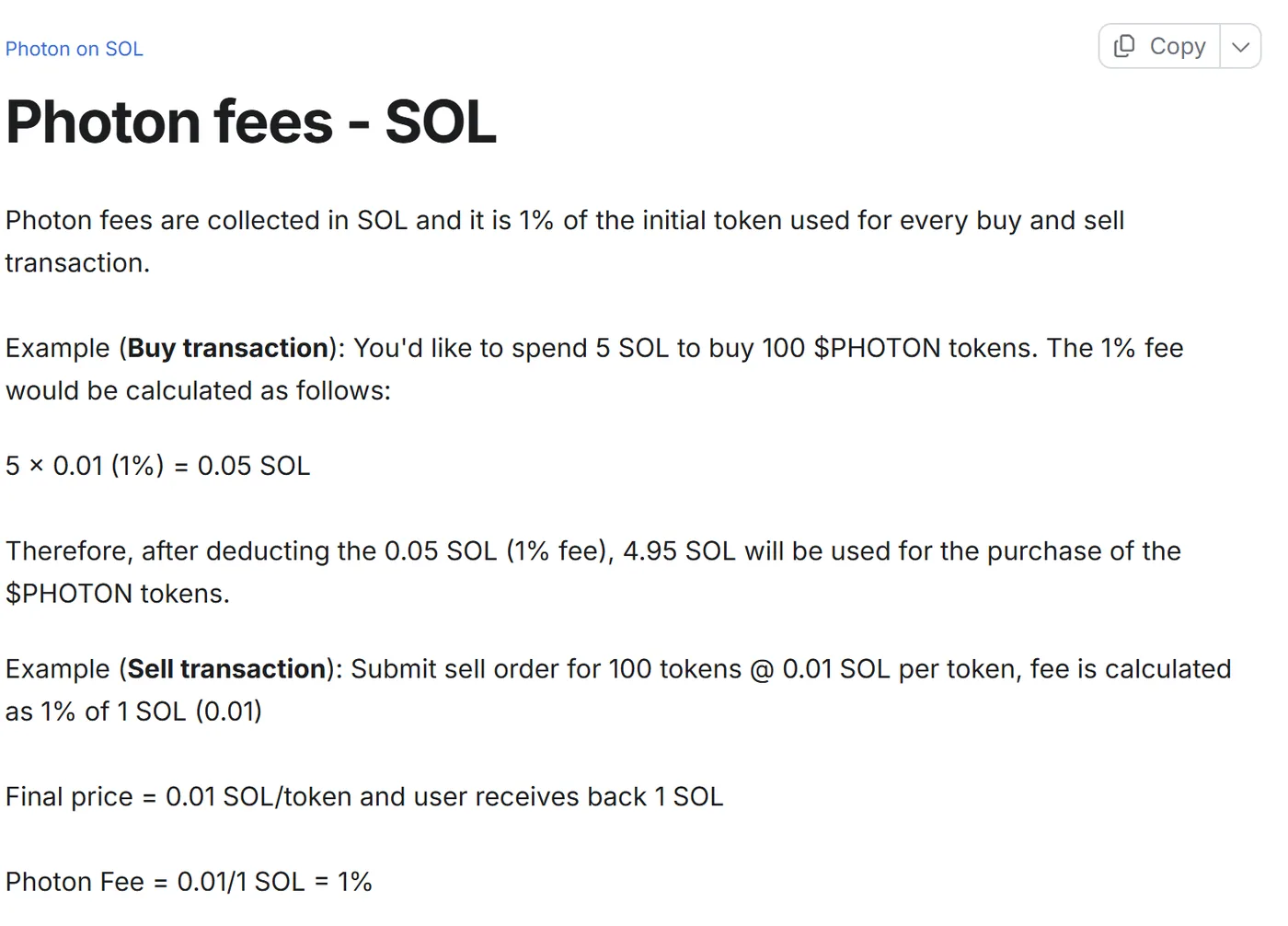
One detail that page carries and no competitor mentions: it is stamped last updated two years ago. The 1% is not a recent repricing, and there is no fee history to compare it against, because this is the only fee schedule Photon has ever published.
The docs give two worked examples, and they are worth reading closely because they show which side of the trade the fee attaches to:
- A 5 SOL buy incurs a 0.05 SOL fee.
- Selling 100 tokens that generate 1 SOL incurs a 0.01 SOL fee.
So on the buy, the 1% comes off the SOL you spend. On the sell, it comes off the SOL your tokens generate. That asymmetry is why a round trip costs slightly more than a naive "1% plus 1%" reading suggests once you account for the sell fee landing on your exit proceeds. More on that below.
Two more things the docs settle:
- Wallet-to-wallet transfers are not charged a Photon fee. Moving SOL between your own addresses does not trigger the 1%. Only buys and sells do.
- The Ethereum-side docs state the same 1%. Photon's ETH deployment now redirects, so treat that page as legacy, but it is consistent rather than contradictory.
And four things the docs do not contain:
| Item | Status in Photon's documentation |
|---|---|
| Volume tier discounts | None documented |
| Withdrawal fees | None documented |
| Fee change history | None documented |
| Published fee schedule for the BNB and Base deployments | None found |
Source for all of the above: Photon's Solana fee page and its Ethereum fee page. You can open the terminal itself at photon-sol.tinyastro.io and check the SOL deducted on your next fill against the number above.
The referral discount that does not exist
You will find pages claiming Photon costs 0.9% with a referral code. That figure is not in Photon's documentation. There is no referral or affiliate page in the GitBook at all, and it does not appear in the docs index. Independent competitor research reaches the same conclusion: no published Photon referral tier exists.
What Photon does document is a Points Leaderboard on the ETH side, where referring someone who then trades earns you points, and the top hundred point holders receive a share of a weekly jackpot. That is a points mechanic, not a discount on your own trading fee. Our referral page covers what is and is not verifiable about it.
The practical read: assume you pay 1%. If somebody quotes you 0.9%, ask them for the Photon-authored page it comes from, because there isn't one.
What is not a Photon fee
This is the section most competing pages skip, and skipping it makes Photon look either cheaper or more expensive than it is depending on which way the author leaned.
When you submit a trade on  Solana through Photon, several separate charges can
apply. Only the first goes to Photon.
Solana through Photon, several separate charges can
apply. Only the first goes to Photon.
1. Photon's platform fee. 1% of the SOL amount, collected in SOL, on the buy and again on the sell.
2. The priority fee. Extra SOL paid to Solana validators to get your transaction included faster. Photon exposes this in Settings and inside each of the S1, S2 and S3 presets, and limit and DCA orders carry their own per-order priority fee. You choose the number. Photon does not receive it.
3. The Jito bribe. A payment to Jito validators to encourage them to pick your transaction up. Also user-configured, also not revenue for Photon. Photon's Smart-MEV Protection determines how the bribe is routed rather than how large it is:
| Mode | Routing rule |
|---|---|
| Fast Mode | Bribes under 0.001 SOL go direct to Jito; larger bribes route via Bloxroute |
| Secure Mode | Same logic, with the threshold set at 0.002 SOL |
| Default Speed | Standard priority and bribe handling |
| Auto Speed | Adjusts priority fee and bribe automatically from recent successful transactions |
Source: Photon's Smart-MEV Protection and Settings pages. The trading guides go into how the presets interact with these settings.
4. The Solana base network fee. Charged by the network per signature. Small enough that it rarely changes a decision, but it is the reason a wallet holding exactly the token you want to sell and no spare SOL cannot sell it. That failure mode shows up constantly in troubleshooting, and our failed transactions guide walks through the fix.
5. The venue's own fee. Photon routes into whatever pool the token lives in, and that pool takes its
own cut. On a fresh launch it is frequently  PumpSwap.
Photon's 1% stacks on top of the venue fee rather than replacing it. We are not printing a PumpSwap rate
here, because the tiering figures that circulate for it are not traceable to a schedule we could verify.
Read the current number at the venue before you size a fresh-launch trade.
PumpSwap.
Photon's 1% stacks on top of the venue fee rather than replacing it. We are not printing a PumpSwap rate
here, because the tiering figures that circulate for it are not traceable to a schedule we could verify.
Read the current number at the venue before you size a fresh-launch trade.
6. Slippage. Not a fee at all, but the largest cost on thin liquidity. A wide slippage tolerance on a shallow pool can cost more than every other line item combined.
Read your total cost, not your platform fee
Total cost of a trade = Photon's 1% + your priority fee + your Jito bribe + the Solana network fee + the venue's pool fee + slippage. Traders who benchmark terminals on the platform fee alone routinely lose more to an aggressive preset and a thin pool than the 1% ever took from them. Photon's fee is the predictable part. The rest is the part you control, and the part that varies most.
Open Photon and check the numbers yourself
Every figure on this page comes from Photon's own documentation or DefiLlama's public API. Place one small trade, read the SOL deducted, and confirm the 1% against your own fill before you size up.
Open PhotonThe fee drag math
Because the buy fee comes off what you spend and the sell fee comes off what you receive, a round trip does not cost exactly 2%. Start with a balance of B. The buy takes 1%, leaving 0.99B deployed into the token. If the position exits flat, it generates 0.99B of SOL, and the sell takes 1% of that. You end with 0.99 x 0.99 = 0.9801 of what you started with.
Each break-even round trip costs 1.99% of the balance. And to actually break even, the token has to rise: you need gross proceeds of B / 0.99 = 1.0101B from an entry of 0.99B, which is a move of 2.0304%. Before any priority fee, any bribe, and any slippage.
Cumulative cost over 10, 50 and 100 round trips
Two ways to read the damage, both on a 5 SOL position, both assuming every trade ends flat before fees:
| Round trips | Fees paid, holding size constant at 5 SOL | Balance left from 5 SOL, compounding | Share of starting balance lost |
|---|---|---|---|
| 1 | 0.10 SOL | 4.9005 SOL | 1.99% |
| 10 | 1.00 SOL | 4.0895 SOL | 18.21% |
| 50 | 5.00 SOL | 1.8302 SOL | 63.40% |
| 100 | 10.00 SOL | 0.6699 SOL | 86.60% |
The middle column is the fee bill if you keep topping the account up to trade a constant 5 SOL: 0.05 SOL on the buy plus 0.05 SOL on the flat sell, ten times, is 1 SOL. The third column is what happens if you just let the balance ride, which is closer to how most memecoin accounts actually work: 5 x 0.9801^n.
At a hundred round trips, a trader who picked tokens exactly as well as a coin flip has handed over 86.6% of the account without ever being wrong about a single trade. Photon's own user complaints about fee drag are describing this table.
The win rate you need
Fees also raise the win rate you need to stay level, and they raise it most for traders taking small moves. Modeling a trader who rolls the full balance into each trade and takes symmetric wins and losses, the geometric break-even win rate looks like this:
| Typical move captured | Break-even win rate, zero fees | Break-even win rate after 1% in and 1% out | Extra hurdle |
|---|---|---|---|
| +10% / -10% | 52.50% | 62.52% | +10.02 points |
| +20% / -20% | 55.03% | 59.99% | +4.96 points |
| +50% / -50% | 63.09% | 64.92% | +1.83 points |
Read the first row twice. A scalper working 10% moves needs to be right 62.5% of the time on Photon to stand still, against 52.5% with no fees. The 1% each way is a ten point handicap on that style. A trader holding for 50% moves barely notices it.
That is the honest answer to "is Photon expensive": it depends entirely on your average holding period and target move. High-frequency flipping on a 1% platform fee is close to unplayable. Taking a handful of larger positions a week, the fee is a rounding error next to your entry quality.
These numbers assume no priority fee, no bribe and no slippage, so treat every one of them as a floor.
The 1% scales with turnover, not with how much capital you hold or how long you hold it. Cutting your round trip count in half cuts your fee bill in half. No setting inside Photon does that for you.
How Photon's 1% compares in 2026
Fee claims in this category are mostly copied between review sites without a source. Here is the cohort with each figure marked by where it actually comes from.
| Platform | Headline fee | Discount path | Source quality |
|---|---|---|---|
| Photon | 1% buy and 1% sell | None published | Official docs, linked above |
| Axiom | 1%, tiering down to 0.75% at Champion level | 0.25% SOL cashback, plus a further 10% off via referral | Official docs, read 2026-08-06, URL not cited here |
| GMGN | 1% handling fee | 0.70% to 0.90% with a referral code (10% to 30% off) | Official docs, linked below |
| Trojan | Around 1%, best achievable around 0.9% | Referral-linked | Not in official docs, secondary sources only |
| BONKbot | 1% | Up to 25% cashback | Official docs, read 2026-08-06, URL not cited here |
| Jupiter | 0 to 10 bps, up to 50 bps on tokens under 24 hours old | n/a | Official docs, read 2026-08-06, URL not cited here |
Where a cell says the URL is not cited here, we read that platform's own fee page on 2026-08-06 and have not republished the link. Photon's and GMGN's fee pages are linked on this page. For the other three, go to the platform's docs and read the current number rather than trusting this row.
 Axiom is the one that matters most, because it is
where Photon's users went. Its published schedule tiers down to 0.75% and pays 0.25% SOL cashback on top,
with an additional 10% off through a referral. That is a cheaper round trip than Photon's flat 2%, and it
is documented rather than rumored. Our sister site
axiompedia.com covers Axiom's tier structure in detail, and the
comparison cluster here runs the head-to-head from Photon's side.
Axiom is the one that matters most, because it is
where Photon's users went. Its published schedule tiers down to 0.75% and pays 0.25% SOL cashback on top,
with an additional 10% off through a referral. That is a cheaper round trip than Photon's flat 2%, and it
is documented rather than rumored. Our sister site
axiompedia.com covers Axiom's tier structure in detail, and the
comparison cluster here runs the head-to-head from Photon's side.
 GMGN documents 1% reducible to 0.70% to 0.90% with a
referral code. Note that some review sites quote GMGN at 1.5%. That number contradicts
GMGN's own fee documentation and should not be used. We work through
how Photon's 1% compares with GMGN's on both rate and chain coverage.
GMGN documents 1% reducible to 0.70% to 0.90% with a
referral code. Note that some review sites quote GMGN at 1.5%. That number contradicts
GMGN's own fee documentation and should not be used. We work through
how Photon's 1% compares with GMGN's on both rate and chain coverage.
 Trojan is widely quoted at 1%, with 0.9% via
referral. We could not find a fee schedule page in Trojan's own documentation, so that figure is
secondary and we are labeling it as such rather than presenting it as confirmed.
Trojan is widely quoted at 1%, with 0.9% via
referral. We could not find a fee schedule page in Trojan's own documentation, so that figure is
secondary and we are labeling it as such rather than presenting it as confirmed.
Bloom, Sigma, Dexcelerate and Slerf Tools have no DefiLlama fee adapter. Searching the obvious slugs returns nothing, which means their revenue figures cannot be independently verified that way. Any fee or volume number circulating for those four is unconfirmed. Sigma's claim of 0% on Solana in particular deserves scrutiny, for a narrow reason: with no fee adapter and no published revenue, how the terminal funds itself is not independently visible. We are not going to guess at the answer, and neither should a page that presents 0% as settled.
Photon's position in this table is the uncomfortable one. It charges the category's standard headline rate and is the only major terminal here with no route to paying less. If you would rather see that as one number per platform than as a row of caveats, we keep the same trade priced on Photon, Axiom and GMGN as a dated index, rebuilt from each schedule rather than from each other.
What the revenue collapse says about the fee
Photon is a real business with real numbers attached, and those numbers are public.
 DefiLlama's
fee adapter for Photon (slug
DefiLlama's
fee adapter for Photon (slug photon, protocol id 4981) has tracked it since launch. Pulled 2026-08-06
from api.llama.fi/summary/fees/photon:
| Metric | Value |
|---|---|
| Lifetime gross fees | $440,842,744 |
| Peak month (January 2025) | $84,588,376 |
| Trailing 30 days | $507,610 |
| Trailing 24 hours | $18,578 |
| 30-day change | -28.1% |
| Share of the named terminal cohort's 30-day fees | 1.26%, 7th place |
Photon launched in January 2024, ramped hard through that year, peaked in January 2025 at roughly $84.6M of monthly fees, and now runs around half a million dollars a month. That is a drawdown of about 99.4% from peak. Over the same stretch, Axiom took 55.3% of the cohort's 30-day fees and GMGN took 23.0%.
The flat 1% is not the only reason, but it is a large one. Traders in this category are price sensitive and mobile, the switching cost between web terminals is close to zero, and the two platforms that took Photon's share both publish a way to pay less. Photon answered with the same rate it launched with.
None of that means the terminal stopped working. It processes trades, the Memescope and order tooling are intact, and there is $440M of lifetime fee revenue behind the operation. It means Photon is no longer the default choice on price, and pages that present it as the cheapest option are not reading the same documentation everyone else can.
Decide with the numbers in front of you
Photon charges a flat 1% each way with no tier and no discount. If your holding period is long enough that a 2% round trip does not decide the trade, the terminal still does its job well. Open it, run a small size, and judge the fill.
Try PhotonHow to check what a trade actually cost you
Everything above is what the documentation says you will pay. Every Photon trade is an ordinary Solana transaction, so what you actually paid is public, and you can check it yourself instead of taking anyone's word for it, ours included.
Open the Holdings tab, find the trade, and copy its transaction signature. Paste that into a Solana block explorer such as Solscan or the official Solana Explorer. Four things on that page answer the question:
The transaction fee field. This is the validator's cut: Solana's base fee of 5,000 lamports per signature plus whatever prioritization fee your preset attached. It is one number covering items 2 and 4 above, and Photon receives none of it.
The SOL balance changes. Photon's 1% appears here as a separate debit from your wallet to a Photon fee account, distinct from the SOL that went into the swap itself. Divide it by the total SOL you put in. It should come to 0.01, and if it does not, you have measured something other than the platform fee.
A transfer to a Jito tip account. If your preset sent a bribe, it shows as its own transfer. No entry means no bribe was paid on that trade, whatever the preset was set to.
The token balance change. Compare the tokens you actually received against the quote you accepted. The gap is your realized slippage, which is usually the largest number on the page and the one no fee table will ever show you.
Do this once on a small trade before you size up. It takes about a minute, and it converts every figure on this page from a claim into something you have verified on your own account.
The number worth writing down
Your realized slippage, not the platform fee. The 1% is fixed and predictable, so it needs checking once. Slippage changes with every pool and every preset, and on a thin launch it can dwarf everything Photon and the validators took combined.
Cutting your actual cost on Photon
You cannot negotiate the 1%. You can change everything around it.
Trade less, size more. This is the only lever that moves the number much. The fee is proportional to turnover, not to time held. Twenty round trips a week at 5 SOL costs 2 SOL in platform fees. Five round trips at 20 SOL costs the same 2 SOL, and gives you four fewer chances to be wrong.
Stop paying for speed you do not need. The priority fee and bribe are yours to set. On an illiquid launch where inclusion order decides the fill, paying up is rational. On an established pool with deep liquidity, an aggressive preset is money spent on nothing. Auto Speed exists precisely so you are not guessing, since it adjusts from recent successful transactions rather than from a number you picked once and forgot. The trading guides walk through configuring S1, S2 and S3 for different situations.
Treat slippage as a cost line, not a setting. Set a 20% tolerance on a shallow pool and you have written a blank check to whoever is on the other side. Check pool depth before you widen it.
Do not round-trip through a transfer. Wallet-to-wallet moves carry no Photon fee, so consolidating across your wallets does not cost you the 1%. Selling in one wallet to buy in another does.
Count the pool fee. On a fresh PumpSwap launch you are paying Photon's 1% plus the venue's fee plus your bribe. Established tokens on deeper pools are cheaper all-in, which the markets pages can help you identify.
Photon's 1% is fixed and easy to predict. The variable costs sitting next to it are where most traders actually lose money, and every one of those is under your control in Settings.
The verdict
Photon's 1% on every buy and every sell is documented, unambiguous, and applied the same way to everyone. There are no tiers to chase, no referral code that shaves it down, and no hidden withdrawal charge waiting at the exit. In a category full of unsourced numbers, that clarity counts for something.
It is also, in 2026, simply more expensive than the alternatives that publish a discount path. If you turn over your balance dozens of times a month, the arithmetic above decides your year. If you take a few considered positions and hold them through real moves, the 1% is a cost you will barely notice next to your entry timing.
Read the fee page, run your own round trip count through the table, and pick accordingly. If you are new to the platform, getting started covers the signup and the one-time private key reveal, security covers verifying you are on the real domain rather than a clone, and the rest of the fee guides go deeper on each cost line. The full guide library and about page explain how this site sources its numbers.
Frequently Asked Questions
One percent of the SOL amount on every buy and every sell, per Photon's own documentation. A 5 SOL buy incurs a 0.05 SOL fee. Selling tokens that generate 1 SOL incurs a 0.01 SOL fee. Wallet-to-wallet transfers are not charged a Photon fee.
No. Photon's documentation contains no volume tiers, no referral discount, no withdrawal fee schedule and no record of past fee changes. The 0.9 percent referral rate that circulates on review sites is not sourced to anything Photon published, so treat it as unverified rather than as a rate you can rely on.
No. Priority fees go to Solana validators and bribes go to Jito validators. You set both yourself in Photon's Settings, per preset or per order. They are real costs to you, but they are not Photon platform fees and Photon does not collect them.
About 2 percent before slippage, priority fees and bribes. Because the sell fee applies to your exit proceeds rather than your entry, a token has to rise roughly 2.03 percent before a round trip breaks even on Photon's fees alone.
No. Axiom's published schedule tiers down to 0.75 percent with SOL cashback, and GMGN documents a 0.70 to 0.90 percent range with a referral code. Photon has no discount path at all, which is one reason its fee revenue has fallen roughly 99 percent from its January 2025 peak.
Independent: PhotonGuides is an independent reference published by Concept211. It is not affiliated with, produced by, reviewed by, endorsed by, or connected to Photon or Tiny Astro Inc., the company named as "the Company" in Photon's own Terms of Use. "Photon" and any related marks belong to their owner and are used here only to identify the product this site writes about. Our only commercial relationship with that product is a publicly available referral link, which gives the reader no discount and costs them nothing.
Disclaimer: Nothing on this site is financial, legal, tax or investment advice, and nothing here is a recommendation to buy or sell any token. Trading Solana tokens, particularly newly launched ones, carries a substantial risk of total loss. Where this site describes what a document says or what a product does, that is an observation and not a conclusion about your obligations. Consult a qualified professional in your own jurisdiction before acting. This site contains referral links, see our full disclaimer for details.
Ready to Start Trading?
Photon builds a Solana wallet in the browser, shows you the private key once, and charges a flat 1% on every buy and every sell. Our referral link costs you nothing extra, because there is no discount to give.
Open Photon