ALL GUIDES
Photon Guides & Tutorials
Everything we have written about the Photon terminal, from the first wallet to the cost arithmetic nobody else publishes. Start at the PhotonGuides homepage for the short version.
About Photon & How to Use These Guides
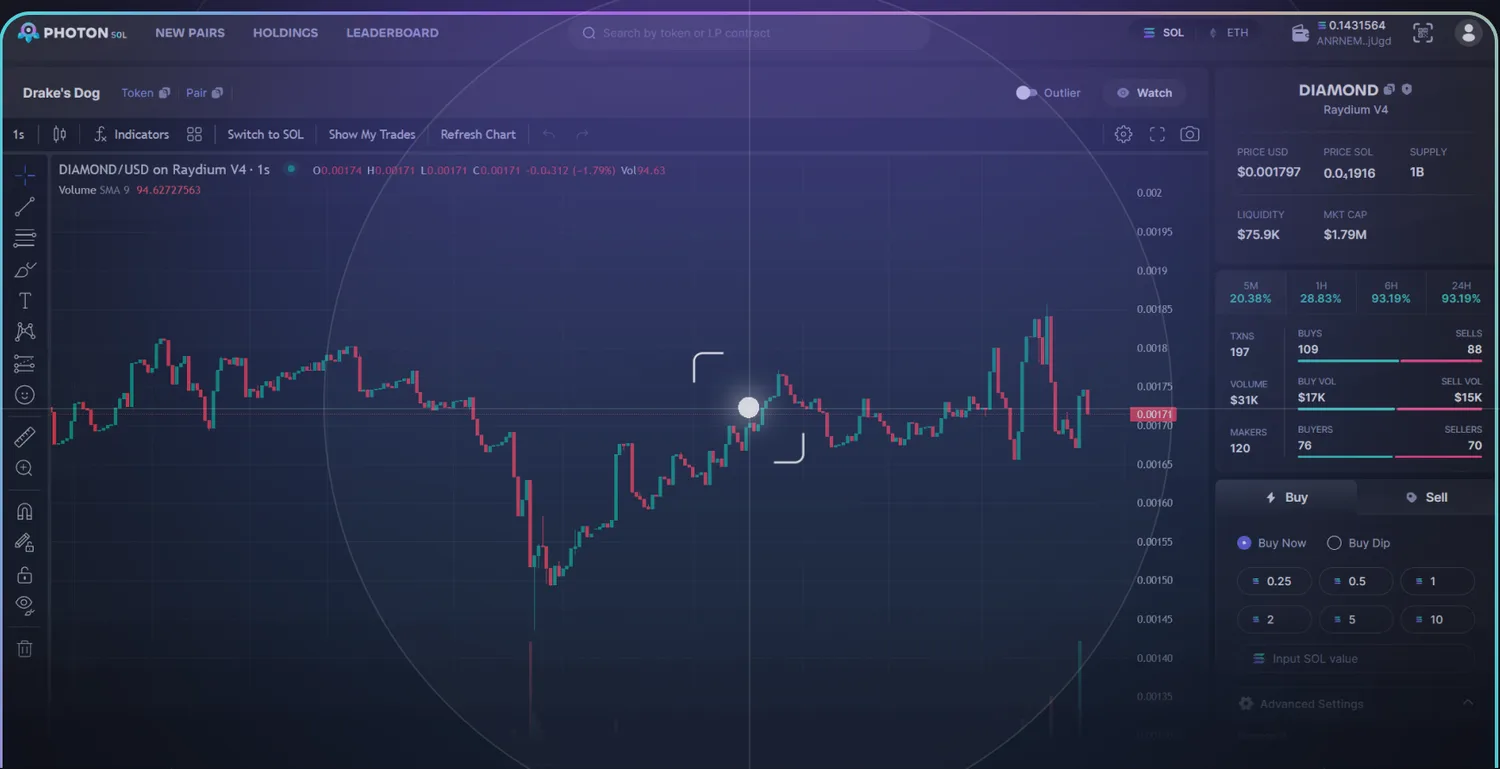
Photon is a browser-based Solana trading terminal, live since January 2024 per DefiLlama's protocol record, whose Terms of Use name Tiny Astro Inc. as the operating company. It does not hold your funds and it does not run its own chain: it creates a Solana wallet for you, hands you the private key once, and gives you a faster interface over existing DEX liquidity than a standard swap page. There is no KYC, no email and no signup form. Photon also operates deployments on BNB Chain and Base under separate subdomains, though its documentation only covers Solana and the now-retired Ethereum deployment in detail. Sources disagree on the current full chain list, so treat any confident "Photon supports X chains" claim, including on other sites, with suspicion. For the long version, our explainer covers what Photon is in full, including the naming confusion with the eight unrelated products that share the word.
The feature people actually come for is Memescope: a customizable dashboard of new Pump.fun and Moonshot tokens you can filter by top-10 holder concentration, developer holding percentage, bonding-curve progress, holder count, liquidity, volume, market cap, and buy or sell activity, with hover-to-pause and a quick-buy button. Around it sit a live pairs feed, a trending page, per-token pages, a holdings view, limit and DCA orders, auto-buy and auto-sell triggers on market-cap moves, Smart-MEV protection in Fast and Secure modes, and up to five wallets per account. Mobile access is through the Phantom wallet's in-app browser, not a native app.
This hub organizes everything into seven sections. Start with Getting Started for the wallet, the one-time private key reveal and your first funded trade. Trading Features covers Memescope filters, order types, the S1/S2/S3 presets and the MEV modes. Fees takes the flat 1% apart and shows what a round trip really costs once priority fees, Jito bribes and venue fees are stacked on it. Terminal Comparisons puts Photon against Axiom, GMGN, Trojan and the rest using DefiLlama fee data with a pull date rather than vendor marketing. Points & Token answers the token and airdrop questions honestly. Security & Custody covers the key reveal, exporting to Phantom, and the fake-Photon sites. And Troubleshooting handles failed transactions, slippage errors and deposits that arrive short.
Why Use Photon, and Why Some People Have Stopped
The case for Photon is execution speed and Memescope, which remains one of the better screening surfaces for new Solana launches. The case against it is arithmetic. Photon charges 1% on every buy and every sell with no volume tiers and no published referral discount, while Axiom publishes tiers down to 0.75% plus cashback and GMGN publishes a 10% to 30% referral discount off its own 1%. That gap shows up in the numbers. Every figure in the rest of this paragraph comes from one pull of the DefiLlama fees API on , not from any platform's own marketing: $440.8M of lifetime fees for Photon, a January 2025 peak of $84.6M in a single month, and $507,610 across the trailing 30 days. That is . Photon still works and still has real users. It is no longer the default, and we would rather say so than sell you a story.
Who These Guides Are For
Three groups. People opening their first Solana terminal should start with Getting Started, which assumes nothing and spends most of its time on the one irreversible step: saving the private key Photon shows you exactly once. Traders coming from another terminal, especially anyone who was on BullX before it stopped trading in June 2026, on Nova, or on Vector before Coinbase shut it down, will get more from Trading Features and Comparisons, which assume you already understand slippage, priority fees and MEV. People searching for a Photon token or airdrop should read Points & Token first, because the answer is short and saves you money: there isn't one, and the tokens trading under that ticker belong to other projects.
Guide Library
Updated August 2026
Getting Started
1 articles
Trading Features
1 articles
Fees Explained
2 articles
Terminal Comparisons
2 articles
Points & Token
2 articles
Security & Custody
1 articles
Troubleshooting
1 articles
Every Guide, and What It Answers
Getting Started
How do you place a first trade on Photon?
Sign up, save the private key at the one moment it is shown, fund with SOL, set a preset, then buy. There is no email, no password and no KYC anywhere in it, which means the reveal screen is the whole security model: Photon's own Terms of Use state the company has no way of granting you access if you lose control of the wallet. Fund with more SOL than you plan to trade, because priority fees and Jito bribes come out of the same balance and a transaction that cannot cover them just fails.
How to Trade on Photon: Complete Beginner's Guide (2026) →12 minFees
What does Photon actually charge, and what is not its fee?
A flat 1% on every buy and every sell, taken in SOL, with no volume tiers and no published referral discount. A round trip that ends flat still costs about 1.99% of the balance. Five other costs land on the same transaction and none of them is Photon's: Solana's 5,000-lamport base fee, the priority fee and Jito bribe you set yourself, the pool's own fee, and slippage. Collapsing those into "Photon charges X%" is the most common error in coverage of this platform.
Photon Fees Explained (2026): The Real Cost of Every Trade →12 minFees
Which Solana terminal is cheapest, once the rates are normalized?
GMGN at a documented 0.70% per side, then Axiom at 0.75% at its top tier, with Photon last at a flat 2.00% per round trip and no way down. But the ranking only matters above roughly 1 SOL of notional: below that, the flat Solana network cost is about half of what a round trip costs you and every terminal pays it identically. Every rate carries its source and read date, and every derived figure is labeled as this site's arithmetic.
The Solana Terminal Fee Index: Photon vs Axiom vs GMGN, Normalized →9 minTerminal Comparisons
Photon vs Axiom (2026): Fees, Features & Which Solana Terminal Wins
Photon vs Axiom compared with sourced numbers: Photon's flat 1% from its own docs, Axiom's tiered 0.75-0.95%, and DefiLlama fee share pulled 2026-08-06.
Photon vs Axiom (2026): Fees, Features & Which Solana Terminal Wins →12 minTerminal Comparisons
Photon vs GMGN (2026): Fees, Chains & Which Terminal Fits Which Job
Photon vs GMGN with sourced numbers: Photon's flat 1% from its own docs, GMGN's 1% reducible to 0.70%, seven chains against one, and DefiLlama fee share pulled 2026-08-06.
Photon vs GMGN (2026): Fees, Chains & Which Terminal Fits Which Job →11 minPoints & Token
What Is Photon? The Solana Trading Terminal Explained (2026)
Photon is a web-based Solana terminal published under the Tiny Astro brand. What it does, the flat 1% fee, and where it stands in 2026 per DefiLlama.
What Is Photon? The Solana Trading Terminal Explained (2026) →10 minSecurity & Custody
Is Photon Safe? Custody, Key Security & the Fake Photon Sites (2026)
Is Photon legit? It is non-custodial, shows your key once, and has no known hack. The real risk is fake Photon sites. What is verified and what is not.
Is Photon Safe? Custody, Key Security & the Fake Photon Sites (2026) →11 minTrading Features
What does each Memescope filter actually screen for?
Concentration, deployer behavior and curve position, and only two of the nine are worth much on their own. Top-10 holder share tells you how few wallets can end the price, developer holding sizes the dump that can land on you, and bonding-curve progress decides whether you are early or crowded. Holder count, buy-sell skew and socials are all trivially manufactured. The page also records what the Default dashboard ships with, read off the running interface on 6 August 2026.
Photon Memescope: What Every Filter Means (2026) →11 minPoints & Token
Is There a Photon Token or Airdrop? The Honest Answer (2026)
No Photon token exists and no Photon airdrop is confirmed. Here is what the Photon Points leaderboard actually is, and why to treat any PHOTON contract as a scam.
Is There a Photon Token or Airdrop? The Honest Answer (2026) →10 minTroubleshooting
Photon Failed Transactions: Every Cause and How to Fix It (2026)
Why Photon trades fail: not enough SOL for fees, slippage, low bribes, congestion, bad token addresses and deposit shortfalls, with the fix for each one.
Photon Failed Transactions: Every Cause and How to Fix It (2026) →10 min
Cite this page
These figures are free to quote. Copy the citation or the link below.
Plain-text citation
PhotonGuides. "Photon Guides & Tutorials." Published August 6, 2026, updated September 1, 2026. https://photonguides.com/guidesHTML link
<a href="https://photonguides.com/guides">Photon Guides & Tutorials, PhotonGuides</a>Methodology and reuse
The revenue, cohort-share and launch-date figures on this page are one pull of Photon's DefiLlama protocol record. The 1% buy and sell rate is quoted from Photon's own fee documentation, and the feature list is read from the running terminal. They were read from the DefiLlama fees API on and re-verified against the live app. Exchanges change their schedules, so treat any figure older than that date as needing a fresh check. The date above is the one to compare against, and our methodology page sets out how every figure on this site is derived.
You may republish these figures with attribution and a link to https://photonguides.com/guides.